 SWISS VIP SERVICE
St. Moritz Skiing: Corviglia, Corvatsch and Diavolezza
9 min read
A planning guide to skiing in St. Moritz: the three ski areas, the usual season, snow, the history of winter tourism, hotels and how to get there.
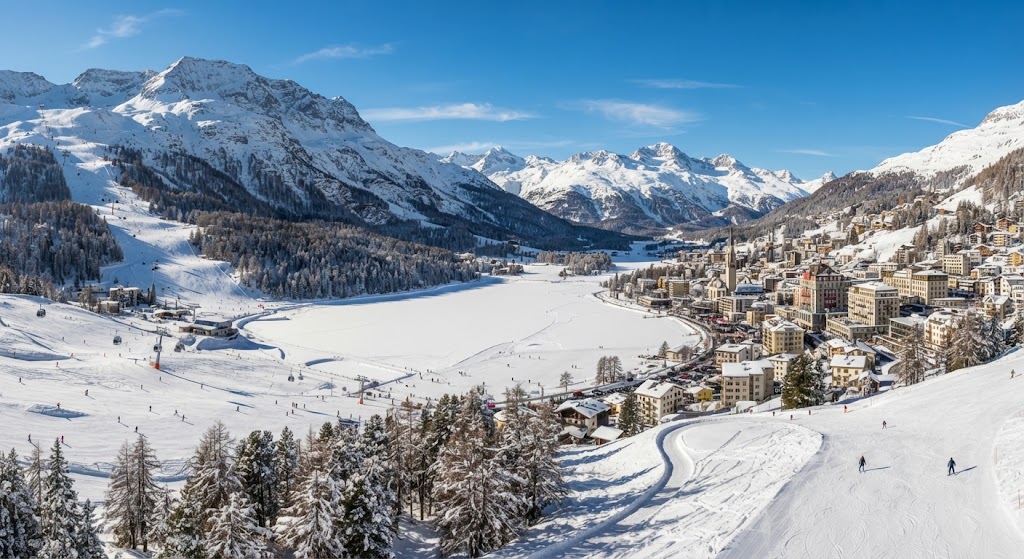
St. Moritz sits in the Upper Engadin, in the south-east of Graubünden, on the shore of its lake and under a sky that the town has made part of its identity. It is a place with a long memory: St. Moritz is described by Switzerland's national tourist board as the birthplace of alpine winter sports, and a visit still feels like a mix of mountain resort, old grand-hotel town and serious ski destination. This guide is for anyone planning a ski trip here: what the slopes are like, when the season usually runs, how the snow behaves, how the story began, where to stay and how to arrive without a headache.
The resort and its three ski areas
There is no single "St. Moritz ski area". The town is the base for three mountains that each have their own character, and the tourism office groups them together under the Engadin St. Moritz name. Corviglia rises directly above the town and is the classic St. Moritz mountain. Corvatsch, across the valley, is the high one. Diavolezza, on the road towards Pontresina and the Bernina Pass, is the glacier outing. A smaller area, Furtschellas, belongs to the same operator as Corvatsch.
The village itself lies at about 1,800 metres, which already explains a good deal. Many guests arrive for the bright mountain light as much as for the skiing, and plan their days around the sun on the terraces of the mountain restaurants.
Corviglia and Piz Nair: the sports mountain
The operator, Engadin St. Moritz Mountains, calls Corviglia the "St. Moritz Sports Mountain" and says it has shaped the region's tourism for over 150 years. The Graubünden tourism page for the area lists 38 pistes with about 155 kilometres in total, split into roughly 42 kilometres of easy runs, 79 kilometres of intermediate runs and 34 kilometres of difficult ones. Figures for pistes and lifts differ a little between sources and from season to season, so treat them as a sense of scale: this is a large, intermediate-friendly area with some real steep terrain, rather than a ski area for experts only.
The mountain is reached from the town by funicular and cable car, and the top of the area is Piz Nair. From there the long runs head back towards St. Moritz, and the views reach over the lake chain of the Engadin to the Bernina range. Because the town sits at the foot of the slopes, many skiers simply finish the day by skiing or riding down to the village.
Arriving from Zürich Airport with skis and luggage? A private transfer takes you from the airport to your hotel door in St. Moritz without changing trains, which is useful when you travel with ski bags and several suitcases. Tell us where you are going and we will come back to you with a personal offer.
Corvatsch and Furtschellas: height and snow parks
The Corvatsch and Diavolezza operator gives the mountain station of Corvatsch as 3,303 metres, the highest in the canton of Graubünden. That altitude is why the area has a reputation for good late-season snow, and the operator states that powder snow is possible there until the end of April. Corvatsch also has a large snow park used for competitions, and the operator advertises its Snow Night on what it calls the longest illuminated slope in Switzerland.
Furtschellas is the smaller of the two areas on this side of the valley. The operator also promotes a Snow Safari, which takes in Furtschellas, Corvatsch and Corviglia in one day. It is a good answer to the question of how to see more of the Engadin in a single outing, and the operator's page explains how it works.
Diavolezza: the glacier and the Bernina view
Diavolezza is a different kind of day. According to the national tourism page for the cable car, the valley station lies at 2,096 metres and the mountain station at 2,978 metres, a climb of 882 metres that takes about seven minutes. On the ride and from the terrace you look across the Pers Glacier and the Morteratsch Glacier, with the rock faces of Piz Palü to one side. Skiing here is a high-alpine experience and the operator describes the glacier run as one of its signature offers. Check the operator's page before you plan a day here, because the area runs to its own calendar.
Season and lift hours
The winter season in St. Moritz usually runs from about late November to early April. For the Corviglia area, the Graubünden tourism page lists daily lift operation from roughly 07:45 to 17:00. Please read those as typical values only. Opening dates, closing dates and lift hours change from year to year, and individual lifts open in stages as the snow allows. The Engadin St. Moritz Mountains website gives the current operating hours for Corviglia, and the Corvatsch and Diavolezza website does the same for its areas. The operator of Diavolezza has even offered autumn skiing on selected days before the main season, so the high areas can open earlier than the rest. We give no ticket prices here, and you will find them with the operators.
Snow: what to expect
Snow reliability in the Engadin comes from altitude and from the dry, cold continental climate of the valley. The upper parts of Corviglia and especially Corvatsch and Diavolezza are high enough for the snow to hold in cold weather, while the lower runs back to the village depend more on conditions. The tourism office's official snow report for St. Moritz shows which lifts and runs are open and how the snow looks today. Check it before you travel and again on the morning you ski, because conditions change daily and we do not quote any snow depth here.
Looking back: how winter tourism started
The story most often told begins in 1864. The Kulm Hotel's own history page says that the hotelier Johannes Badrutt invited four English summer guests back for a December stay, promising to refund their journey if they did not come to appreciate the Engadin in winter. They accepted and stayed until Easter. The wager is the origin story of winter tourism in the Alps, and it happened right here.
The Kulm later hosted two Winter Olympics. According to the hotel, the 1928 Games held their opening ceremonies, figure skating and ice hockey in the Kulm Park, and the 1948 Games again used the park for the opening and other events. St. Moritz is one of very few places to have hosted the Winter Games twice. The nearby Olympic bob run between St. Moritz and Celerina, a natural ice track, is still described by the national tourist board as one of the resort's attractions.
Also from this era comes the Cresta Run, the skeleton ice channel. Its club says the first run was completed in January 1885 and that the St. Moritz Tobogganing Club was founded in 1887. The run is about 1,212 metres long, drops 157 metres, has ten named corners including the famous Shuttlecock, and is rebuilt each winter from snow and ice. It usually opens before Christmas and runs for about ten weeks. Most visitors come to watch from the bank, and that is a very good way to spend a quiet afternoon.
A chauffeur for the day, on site. The three ski areas lie in different parts of the valley, and hotels, lifts and restaurants are not all within walking distance of one another. A private chauffeur by the hour can stay with you for the day and drive you between hotel, lifts and dinner. Tell us where you are going and we will come back to you with a personal offer.
Beyond skiing
St. Moritz is also a place for people who do not ski every day. The national tourist board mentions horse races on the frozen lake, the Engadin ski marathon on cross-country trails across the lakes, and winter walking paths. The operator of the Corviglia area also runs the railway to Muottas Muragl, where a sledding run of about four kilometres and twenty turns descends 718 metres. The town's shops and the old village around the Via Maistra are within easy walking distance of the hotels, and many guests spend a rest day this way.
Where to stay near the slopes
The hotels below are well-known addresses, and each has its own website for current availability and details. We give no ratings and no prices.
Kulm Hotel St. Moritz sits above the lake and, as the history above shows, has been part of the winter story since 1864.
Suvretta House is one of the best-known hotels in the Upper Engadin; its website describes it as a hotel for generations since 1912.
Hotel Schweizerhof is in the centre of St. Moritz Dorf. The hotel says it is just three minutes from the Chantarella funicular, which takes you up to Corviglia.
Whichever address you choose, ask about the distance to the nearest lift station and about the hotel's own winter season, because some close for part of the year.
Getting there
By train, the most memorable approach is the narrow-gauge line of the Rhaetian Railway, which the national tourist board describes as a UNESCO World Heritage line. The Bernina Express runs from St. Moritz to Tirano, and the Glacier Express runs between St. Moritz and Zermatt. For the timetable from your own starting point, use the SBB website. Most international guests fly into Zürich Airport, from where you continue by train or by road. We state no journey times here; the official timetables and your route planner give current ones.
By road, winter conditions in the mountains can change quickly. If you would rather not drive in snow yourself, that is an argument for a driver.
Make the return trip a day out. If your plans allow a stop on the way back, a private tour can turn the drive home into part of the holiday. Tell us where you are going and we will come back to you with a personal offer.
A simple plan for your first visit
Give the first day to Corviglia, where the town is at the bottom of the slopes and orientation is easy. Use the second for Corvatsch if conditions favour the high terrain, and the third for Diavolezza or the Snow Safari. Keep an afternoon for the Cresta Run bank, a walk on the lake, or the old village. And check each operator's website the evening before you ski, because lifts, hours and snow are what change.
Written by Swiss VIP Service