 SWISS VIP SERVICE
Skiing in Verbier and the 4 Vallées
9 min read
Verbier opens onto the 4 Vallées, the largest connected ski area in Switzerland. How the sectors fit together, what to check about season and snow, where to stay and how to arrive.
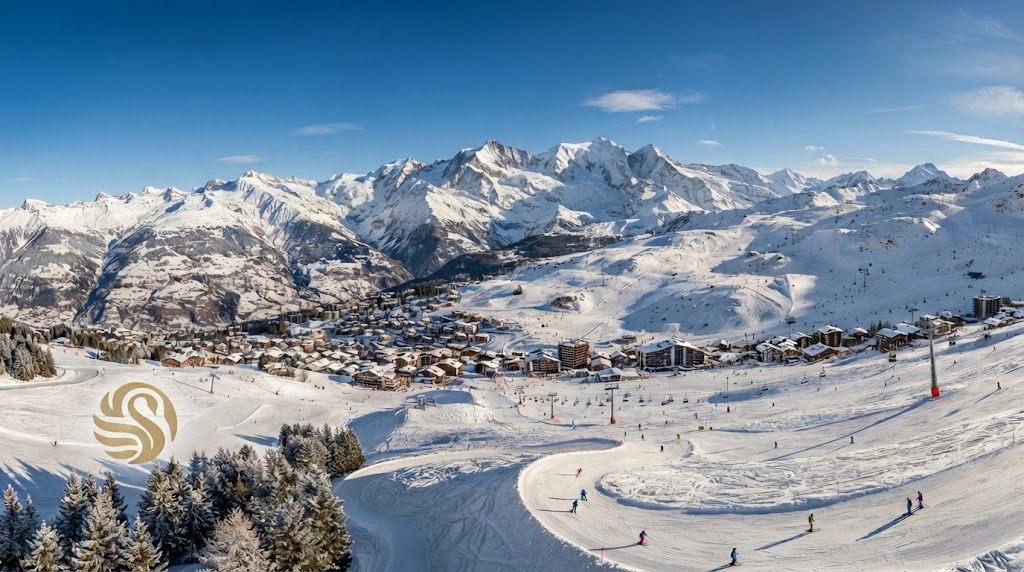
Verbier sits on a sunny terrace high above the Val de Bagnes in the Valais, and its lifts open the door to the 4 Vallées, the largest connected ski area in Switzerland. People come for the long, varied descents, for some of the most talked-about off-piste terrain in the Alps and for a village with a lively evening life. This guide explains how the ski area is laid out, what to know about the season and the snow, where skiing in Verbier began, where to stay and how to arrive with luggage and skis.
Verbier and the Four Valleys: the resort and its slopes
The village of Verbier lies at about 1,500 metres, and the skiing in Verbier itself runs from roughly 1,500 up to 2,700 metres. The highest point of the whole 4 Vallées is Mont-Fort at 3,330 metres. The lift company and the tourist office both speak of more than 400 kilometres of slopes, with the figure of 410 kilometres appearing on the official sites. That makes it a place where you can ski for a week without repeating yourself.
The ski pass covers four sectors: Bruson, La Tzoumaz and Savoleyres, Verbier itself, and the 4 Vallées as a whole. Bruson is the quiet one, with runs between 1,080 and 2,200 metres. La Tzoumaz and Savoleyres span 1,500 to 2,354 metres, and Savoleyres is where families and relaxed skiers tend to head. The central Verbier sector, with its big bowls above the village, is the busiest and most varied, and from Col des Gentianes the cable car climbs towards Mont-Fort and the highest skiing of the area.
A chauffeur for the whole day. Verbier is spread along a slope, and the lifts, the hotel and the evening restaurant are rarely in the same place. If you want a driver at your disposal for a day, to take you to the lifts and to wait while you ski, our chauffeur service by the hour stays with you. Tell us what you have in mind and we will come back to you with a personal offer.
For beginners there is a dedicated beginners sector. Children and snowboarders are looked after as well: La Chaux has the main snow park, together with a skicross course and a mini speed-skiing track, while Savoleyres has a fun slope and slalom courses. Lessons and guides are listed under ski schools and guide offices, and the resort also lists independent instructors and mountain guides for private tuition.
If you want to see the whole area before you choose a route, the official interactive piste map shows every lift and run. It is worth studying it the evening before, because the connections between the valleys are what make this area special, and a day that wanders from Verbier towards Nendaz and back is a different experience from a day spent on one hill.
Off the groomed runs: freeride and ski touring
Verbier is known worldwide for what lies between the pistes. The itineraries around Mont Gelé and the slopes beneath Tortin are among the best-known in the Alps, and the resort promotes freeride and heliskiing in complete safety as part of its offer. The words that matter are in the title. Off-piste terrain here is serious terrain, with steep faces, couloirs and glaciated ground, and it belongs to people who carry avalanche equipment and know how to use it, or who go with a guide.
Anyone who wants to learn the ground should book one of the independent mountain guides for a first day. Those who prefer to climb for their descent can look at the resort's page on ski touring. The resort also publishes its safety rules, and the independent avalanche bulletin on WhiteRisk is linked from the lift company's own pages. Read both before you leave the marked runs.
Season and opening times
According to the lift company, the area is open for skiing from about the end of November to the end of April. The official tourist office describes the same pattern: the season usually starts at the end of November and ends in late April, depending on conditions. December to April is the core of the season. January and February usually bring the coldest snow, while March and April bring longer days and more sun.
Those are typical dates and nothing more. The sectors do not all open on the same day: Verbier, La Tzoumaz, the 4 Vallées and Bruson each have their own start and end, and these change from year to year. The same is true of the daily lift hours. We therefore do not print any dates or times here. The current ones, updated through the day, are on the lift company's page with live winter information, which shows which lifts and runs are open. Check it before you book anything that depends on a particular lift.
Snow
The resort describes its snow as high-quality natural snow cover and says that an efficient snowmaking system supports the season. The variety of altitude helps. The slopes above the village run to 2,700 metres, and the higher parts of the 4 Vallées reach up towards Mont-Fort at 3,330 metres, so the area does not depend only on the weather at village level. Aspect matters too: some of the big bowls face north and hold cold snow longer, while the sunny terraces above the village warm up faster in the spring.
What the snow is doing today is something only the official live pages can tell you. Check the weather page of the tourist office, the webcams and the lift company's live openings before you travel and again on the morning you ski. We do not quote snow depths, because they change every day.
Looking back: how skiing came to Verbier
Verbier was a mountain village long before it was a ski resort. The tourist office's own timeline records that the Cabane Mont Fort was built in 1925, which it calls the first real sign of tourism, and that the Swiss ski school was founded in 1933. A road linked Le Châble with Verbier in 1935.
The decisive year was 1950, when the first chairlift between Médran and Les Ruinettes opened, an event the tourist office credits with starting the skiing boom. A train reached Le Châble in 1953, which made the journey from the plains far easier, and in 1983 a cable car reached Mont-Fort. In 1996 the first Xtreme Verbier took place, the freeride competition that has shaped the resort's reputation among skiers and snowboarders ever since. More recently, in 2013, the gondola from Le Châble to Bruson opened and joined that sector to the rest of the area.
Where to stay
Verbier has a large number of chalets and apartments, but a few hotels are good starting points, depending on how close to the lifts you want to be.
Hôtel Farinet stands on the Place Centrale in the middle of the village, and the tourist office describes it as a five-minute walk from the ski lifts.
Hôtel de Verbier is also on the central square, the right choice if you like to step out of the door into the village.
W Verbier is at 1,530 metres in the centre of the resort. The tourist office lists it as at the bottom of the slopes and accessible on skis.
Hôtel Montpelier is a few minutes' walk from the centre, with a free bus stop about 100 metres away that takes guests to the foot of the ski area.
Chalet d'Adrien overlooks the village from the Route des Creux and is a quieter, more private base.
The tourist office keeps a longer list of hotels and of all other accommodation, including chalets and apartments. Ask each place directly how it connects to the lifts in the season you plan to travel, because a short distance on the map can feel long in ski boots.
Getting there
By train, you travel to Le Châble in the valley, then continue for about 20 minutes to Verbier by bus or by cable car. According to the tourist office, the journey from Geneva takes around two hours forty and from Zürich around four hours. Timetables are on the SBB website. On winter weekends and public holidays, the direct Verbier Express runs from Geneva Airport to Le Châble.
By road, the tourist office gives about 1 hour 50 minutes from Geneva Airport and about 3 hours 15 minutes from Zürich Airport. These times are approximate and depend on traffic and on the weather. Snow chains may be required between Le Châble and Verbier after heavy snowfall, and winter tyres are strongly recommended. The official page on getting to Verbier has the current advice.
From the airport to your door. Skis, boots and winter luggage do not fit comfortably onto a connecting train. A private transfer from Zürich Airport or from another station or address takes you to your accommodation without changing, and we can discuss the route with you beforehand. Tell us where you are travelling from and we will come back to you with a personal offer.
Planning a few days in Verbier
A good first day keeps to groomed runs to learn the layout. Spend the second day in a different sector, perhaps Savoleyres for the views and the quieter slopes or Bruson for an easy day out. Keep the highest terrain of the 4 Vallées for a day with clear weather and good visibility, and hire a guide if you want to ski off the marked runs. Evenings in Verbier are social, with many restaurants and bars, so a day without skiing is not wasted.
Travelling in winter also means allowing time. Roads can be busy on Saturdays, lifts can have queues in school holidays, and the weather in the mountains can close higher sectors at short notice. Plan the day around the live information, and keep a second option for a day of poor visibility.
Make the journey part of the trip. If you would like to arrive in or leave the Valais by a different route, with a stop that appeals to you on the way, our private tours can be arranged around your plans. Tell us where you are going and we will come back to you with a personal offer.
Before you go, bookmark three official pages: the live information for the lifts, the tourist office's website for everything off the slopes, and the avalanche bulletin if you plan to leave the pistes. With those in hand, Verbier is an easy resort to plan and a hard one to leave.
Written by Swiss VIP Service