 SWISS VIP SERVICE
Skiing in Zermatt beneath the Matterhorn
10 min read
Zermatt's ski area climbs to 3,883 metres beneath the Matterhorn. How the four areas fit together, what to check about season and snow, where to stay and how to arrive.
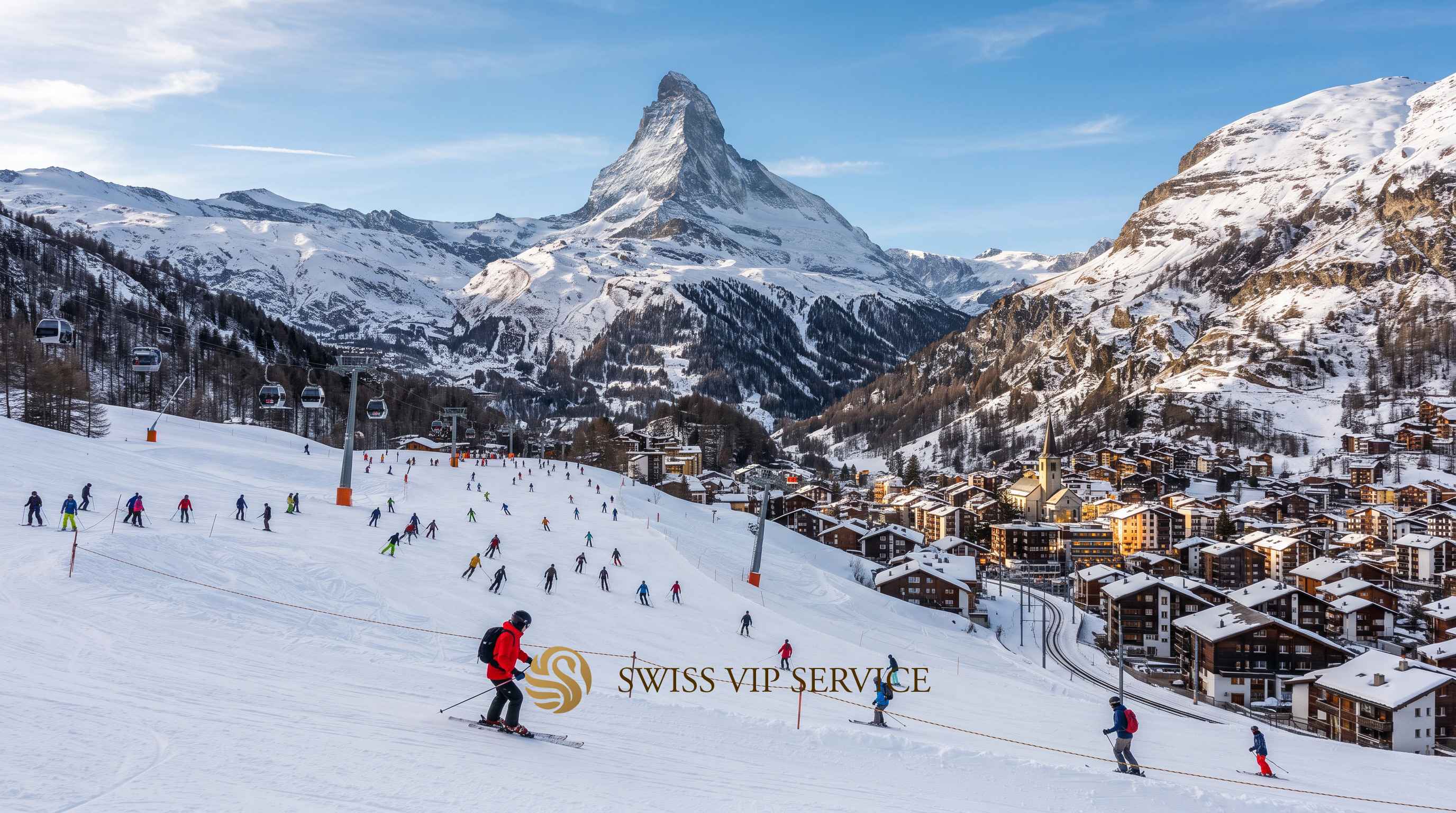
Few ski resorts are as easy to recognise as Zermatt. The Matterhorn stands at the head of the valley, the village below it has no cars on its streets, and the lifts climb from the valley floor to a glacier at almost 3,900 metres. It is a resort for people who want serious altitude, long descents and a village that still feels like a village. This guide explains how the ski area is laid out, what to know about the season and the snow, where skiing in Zermatt began, where to stay and how to get there with luggage and skis.
The ski area at a glance
According to Zermatt Tourism, the Swiss side of the ski area has about 200 kilometres of pistes, and the highest point is the Matterhorn Glacier Paradise at 3,883 metres. Add the Italian resorts of Breuil-Cervinia and Valtournenche, which are reached on skis across the border, and the total grows to as much as 360 kilometres. That bigger figure needs an international ski pass; a standard Zermatt pass covers only the Swiss area. The details of passes and what they include are on the official ski pass page, and we leave the question of cost to that page.
The area is best understood as four parts, each with its own character. Picking the right part for the day, and for the weather, matters more here than in a compact resort.
The four areas and their best-known slopes
Sunnegga, Blauherd and Rothorn
The first area climbs from the village by way of Sunnegga and Blauherd to the Rothorn. Zermatt Tourism describes these as the sunny pistes, with varied runs and views of the Matterhorn. Mixed groups often start here because the terrain is varied and the mountain is in view at every turn. The lift system is operated by Zermatt Bergbahnen, whose site shows which lifts and pistes are open on a given day.
Gornergrat
The second area is reached by the Gornergrat Bahn, the cogwheel railway that climbs to about 3,100 metres. From the top there is a view of the Matterhorn, of the Gorner Glacier and of 28 four-thousand-metre peaks. Skiing here is about scenery as much as about the runs, and the railway makes it a different way up the mountain from the cable cars. At the summit stands the 3100 Kulmhotel Gornergrat,a place to stop at altitude.
Matterhorn Glacier Paradise
The third area is the high one. The Matterhorn Glacier Paradise station sits at 3,883 metres, and the glacier runs around it are the reason snow in Zermatt is so dependable. Zermatt Tourism also describes summer skiing on the glacier, subject to snow, weather and lift operation, which says a lot about the altitude involved. At this height it is much colder than in the village, so dress for the summit rather than for the street.
Cervinia and Valtournenche
The fourth area lies in Italy. From the glacier you can ski down to Cervinia and the Valtournenche valley, have lunch on the Italian side and return by lift. Remember that this crossing requires the international pass, and that the lifts that bring you back have a last departure. Check the closing time on the day before you cross the border.
Arriving with skis? A ski holiday begins on the road or at the airport, and a transfer takes the effort out of it. If you tell us where you are travelling from and where you are going, we will come back to you with a personal offer for a private transfer from the airport or station to the door of your hotel or to the valley.
Opening times and the length of the season
Zermatt has one of the longest ski seasons in the Alps, and the official site describes it that way: March is generally still very good, October can be possible depending on which lifts and slopes are open, and the glacier is open for skiing in summer depending on snow and weather. The lift company publishes a winter timetable each year, and dates, first and last lift departures and the list of open slopes differ from one season to the next and sometimes from one week to the next.
We therefore give no dates and no hours here. The sensible habit is to check two pages before you set out: the operating hours page of Zermatt Bergbahnen and the lifts and pistes page of Zermatt Tourism. The Gornergrat Bahn, which has its own timetable, is covered on its timetable page. A live piste map shows what is open at that moment.
One practical point: whichever area you choose, find out the time of the last lift down before you start, not after lunch.
Snow: why Zermatt is reliable
Reliability comes from altitude and exposure. With the top of the area at 3,883 metres and glacier runs on the high mountain, Zermatt can offer skiing long after many lower resorts have closed, which is why the official site speaks of March as generally good and October as possible. The sunny slopes around Sunnegga and Rothorn face the sun, while the glacier is the high-alpine part of the area. That mix lets you choose your conditions by choosing your lift.
The official pages we consulted do not describe snowmaking or grooming in detail, so we say nothing about them. What we can say is where to look: the snow report of Zermatt Tourism and the snow report of the lift company show the current situation. Read one of them the evening before and again in the morning. We deliberately print no snow depth in this article, because it would be out of date by the time you read it.
Looking back: how skiing came to Zermatt
For a long time Zermatt was a summer resort for climbers, and the winter was quiet. The change begins with the Gornergrat railway: according to the company, winter operation started on Christmas Day 1928, with the first sports trains running to Riffelalp. In 1940 Zermatt counted 1,799 winter visitors; the railway's own history reports that in 1941 operation was extended to Riffelberg and the Gornergrat and that the number rose above 11,000, and above 20,000 in 1945. For its 25th winter anniversary in 1953, the company introduced its first ski pass.
Since then the lifts have multiplied, and the village has grown into one of the most visited places in the Alps; the railway's history also notes almost 800,000 overnight stays in the winter of 2022/23. A recent ambition has been to link Zermatt and Cervinia for racing. The Matterhorn Cervino Speed Opening was planned as the first cross-border World Cup downhill, starting high above Zermatt and finishing in Italy, but warm weather in early November has so far prevented the races from being held. Whether they ever take place is for the organisers to say; the plan alone shows how high and how international this ski area is.
Where to stay
Zermatt rewards a little planning when it comes to hotels, because the position decides whether you walk to a lift or ride to one. These are well-known addresses, listed by position rather than ranked.
Grand Hotel Zermatterhof – on Bahnhofstrasse in the centre of the village, a landmark since 1879. Its website is zermatterhof.ch.
Mont Cervin Palace – also on Bahnhofstrasse, in the village centre. Further details are on the hotel's site.
Riffelalp Resort 2222m – up on the mountain at 2,222 metres. The resort advertises ski-in, ski-out access, which means you leave the village behind and wake up on the slopes.
3100 Kulmhotel Gornergrat – at 3,100 metres, at the summit station of the railway. The ride up from Zermatt takes about 33 minutes.
The two village hotels suit a stay where the village is part of the plan. The mountain hotels suit a stay in which the slopes come first.
Getting there
By train
Zermatt is car-free, and the train goes right into the village. Zermatt Tourism says that trains run about every half hour and that the journey from Zürich Airport takes about three and a half hours, and about four hours from the airports of Geneva and Basel. The line is run by the Matterhorn Gotthard Bahn, and onward connections can be planned on the SBB website. The railways offer a luggage service to the village, which is worth knowing about if you are travelling with skis and several bags. See the arrival page for the details.
By car
Private cars stop at Täsch. The Matterhorn Terminal there has about 2,100 covered spaces, and a shuttle train takes roughly twelve minutes to central Zermatt, leaving about every twenty minutes. An e-taxi is the alternative. Driving further without authorisation can lead to large fines, and electric cars follow the same rules. Zermatt Tourism also publishes a page on car parks and taxi transfers.
The arrival at Zürich Airport is where many trips begin, and the way you handle the first leg sets the tone for the whole holiday.
A driver for the whole day or the whole weekend. In Zermatt itself you travel on foot, by e-taxi and by lift, but the days around it are different. If you want a chauffeur at your disposal for a day, to take you to the valley station, to wait while you ski and to bring you onward afterwards, our chauffeur service by the hour stays with you. Get in touch and tell us your plans, and we will come back to you with a personal offer.
Skiing in the village and beyond
Zermatt's calm is part of the appeal. With no cars on the streets, the evening is quiet, so allow time for the village itself. Zermatt Tourism lists ski and snowboard schools for those who want lessons or a guide for the day, and it is good to book that before the season begins.
Weather matters here more than almost anywhere. A day of wind can close the highest lifts, and the Italian crossing depends on visibility. A good rule is to keep a second plan, such as a lower area or a railway trip to the Gornergrat, in the back of your mind.
Making the journey part of the trip
The Valais is also a region to see on the way home. From Zermatt the line runs back down the valley, and a private journey allows you to stop where you like, rather than where a timetable says.
Go home by another route. If you would like to combine the journey from or to the mountains with a stop that appeals to you, our private tours can be arranged to suit your plans. Tell us where you are going and we will come back to you with a personal offer.
In short, Zermatt offers high skiing, a long season, an unusual village and the added possibility of crossing into Italy. Prepare for the day by reading the official lift and snow pages, choose your hotel according to the part of the mountain you want to ski, and think early about the road to the valley station. The rest is the Matterhorn, standing at the top of the street.
Written by Swiss VIP Service