 SWISS VIP SERVICE
Lucerne in one day: Chapel Bridge, the lake and Mount Pilatus
9 min read
How to spend one day in Lucerne: the Chapel Bridge and old town in the morning, a boat on the lake at midday, and Mount Pilatus in the afternoon.
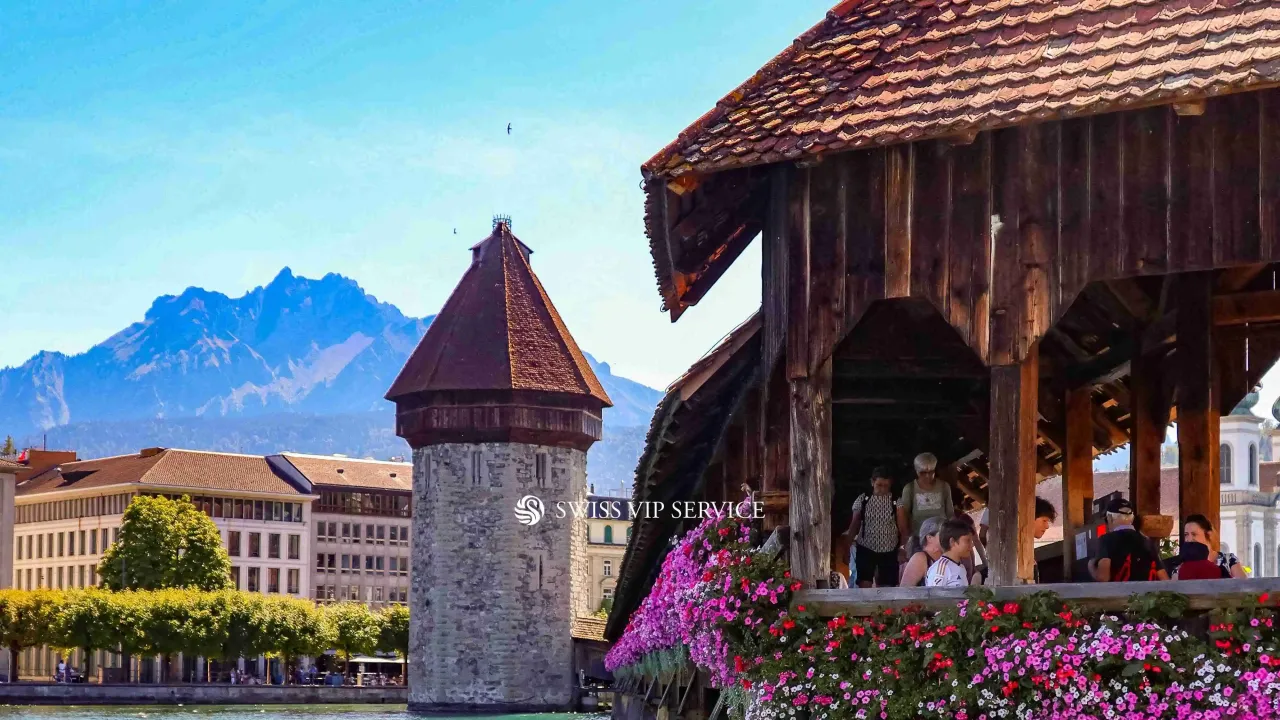
Lucerne is small enough to cross on foot in half an hour and rich enough to fill several days. Its old town sits on the river Reuss where it leaves the lake, a wooden bridge runs diagonally across the water, and on the horizon stands Mount Pilatus. If you only have one day, the trick is not to see everything but to put three things in a sensible order: the old town in the morning, the lake and the mountain in the middle of the day, and one slow, good-looking hour at the end. This is how that day can work, with the official pages you will want for the details that change.
Start at the Chapel Bridge and the Water Tower
Begin where almost every visit to Lucerne begins, at the Chapel Bridge and its Water Tower. Go early, before the tour groups, and walk the whole length of the covered bridge instead of photographing it from the quay. Under the roof beams hang triangular painted panels. According to the city's tourist office, the bridge originally carried 158 of them, a series devised by Renward Cysat and finalised in 1611, each paid for by a wealthy family.
The Water Tower is older than the bridge, dating from around 1290 to 1300, and it has been a lookout, an archive, a treasury and a prison in its time. On the night of 18 August 1993 a fire destroyed most of the bridge; only the two bridgeheads and the tower survived. The bridge was rebuilt within eight months and reopened on 14 April 1994. When you look up at the paintings, remember that a good number of them are careful replacements for panels that burned.
Arriving without a car in Lucerne? We can collect you from Zürich Airport or a Zürich hotel and bring you straight to the old town, so your day starts at the bridge and not in a ticket queue. Tell us where you are going and we will come back to you with a personal offer: private transfers.
The old town on both banks of the Reuss
From the bridge, cross the river and wander. The old town has painted house facades, small squares, and the river at every turn. Two more landmarks are worth a slow detour. The Spreuer Bridge is the second of the covered bridges; its southern half dates from 1408, and beneath its roof hangs the Dance of Death cycle that Caspar Meglinger painted between 1625 and 1635. The theme is that death comes for everyone, whatever their rank, and the effect, a few steps from a busy weir, is oddly gripping.
On the right bank, the Jesuit Church stands directly on the Reuss. Building began in 1666 and the church was inaugurated in 1677; the tourist office calls it Switzerland's first baroque sacred building. Step inside for the white and gold stucco, then step out again, because the point of this morning is to keep moving.
The Lion Monument
A ten-minute walk from the old town leads to the Lion Monument, which has drawn visitors for two centuries. A dying lion is carved into the rock face. It was inaugurated in 1821, to a design by the Danish sculptor Bertel Thorvaldsen, and measures roughly ten by six metres. It commemorates the Swiss Guards who died defending the Tuileries Palace in Paris on 10 August 1792. Allow a quarter of an hour; it makes a quieter stop than the bridge.
Walk the Musegg Wall
If the weather and the season allow, climb to the Musegg Wall on the hill above the old town. About 800 metres of medieval fortification survive, with nine towers, in the form we see today since around 1400. Three of the towers, the Männli, the Zyt and the Schirmer, can be climbed, while the Zyt tower, built in 1442, carries a clock. The walls are usually closed for the winter, roughly from early November to the end of March, and the hours are published on the Musegg Wall website, so check them before you plan around it.
Each tower has its own character: the Nölli, dated 1513, is the only round one, and the Heu tower, rebuilt after an explosion caused by lightning in 1701, rises to 44 metres.
A museum if the weather turns
Lucerne is a good city for a rainy day, and two buildings are worth knowing. The Swiss Museum of Transport, open since 1959, covers travel on rail, road, water and in the air and in space, over roughly 20,000 square metres, with a planetarium and a large-format cinema. And the KKL Lucerne, the culture and congress centre beside the station, is by Jean Nouvel. Its concert hall, with 1,898 seats and acoustics by Russell Johnson, opened in 1998 with the festival that is now the Lucerne Festival. The building is worth a look from outside even if you have no ticket.
Out onto the lake by boat
Around midday, trade the old town for the water. The Lake Lucerne Navigation Company runs the scheduled boats from the piers by the station, and its timetable is the page to use because departures vary with the season and the day of the week. You do not need to commit to a long cruise. A short stretch on the open deck, with the mountains opening up on either side, is enough to understand why people have been writing about this lake for centuries.
The boat is also the gentlest way to reach the mountain. Boats to Alpnachstad connect with the cogwheel railway up Mount Pilatus, which makes the lake a part of the journey rather than a detour.
Want the whole day without logistics? A private chauffeur can stay with you from the morning until the evening, wait while you walk the bridges and the wall, and take you to the pier or the valley station when you are ready. Ask us about a chauffeur by the hour and we will come back to you with a personal offer.
Mount Pilatus and the Golden Round Trip
Mount Pilatus is the mountain you have been looking at all morning, and Pilatus-Bahnen make it easy to climb. The classic day out is the Golden Round Trip, which combines a boat, the cogwheel railway, an aerial cableway, panorama gondolas and a bus. You can go in either direction. Counter-clockwise, you take the bus to Kriens, then the gondolas and the aerial cableway up, and come back down by cogwheel railway and boat; clockwise, you start with the boat and the railway and descend by cableway, gondola and bus. The summit stands at 2,132 metres and the panorama is 360 degrees on a clear day.
The cogwheel railway from Alpnachstad is a sight in itself. The railway describes itself as the steepest cogwheel railway in the world, with a maximum gradient of 48 percent over a line of 4,618 metres. It opened in 1889 as a steam railway and has run on electricity since 1937. The other half of the loop is the Dragon Ride aerial cableway, which links the summit with Fräkmüntegg, where the panorama gondolas down to Kriens begin.
A few cautions. The round trip is a seasonal product, usually from May to October, and in the weeks after it ends the gondolas and the cable car are closed for maintenance, so that only the cogwheel railway from Alpnachstad runs. Weather decides everything on a mountain; check the operator's page on the morning you go, and if it is clouded in, spend the afternoon in the town. Allow most of an afternoon for the whole loop.
A sensible shape for the day
Put together, the day can run like this. Spend the morning in the old town: the Chapel Bridge, the Spreuer Bridge, the Jesuit Church, and the Lion Monument. Eat something simple by the river. Take a boat at midday, either a short loop or the Alpnachstad leg, and go up Pilatus in the afternoon if the sky is clear. Come back for an early evening by the lake and, if you have energy, the Musegg Wall.
If you arrive by train, the SBB timetable is the place to check connections, and the old town is a few minutes' walk from the station. If you would like to see more of central Switzerland than a single day allows, do not try to squeeze it all in. Choose between the mountain and the old town, or give Lucerne two days.
Making the day easier
A single day in Lucerne rewards a little planning more than a long list. Keep the afternoon flexible in case the weather turns, and carry a warm layer, because the summit, at 2,132 metres, is far cooler than the quay. Wear shoes for cobbles and stairs. The bridges and the old town are best at the edges of the day, when the light is low and the crowds thin.
Combining Lucerne with other places? If you would like to see more than the city, we can plan a private tour of central Switzerland around the stops you choose, with a single driver and no timetable to chase. Tell us what you would like to see and we will come back to you with a personal offer: private tours.
Questions visitors ask
Is one day enough?
It is enough for the old town, the lake and one mountain trip if you keep a steady pace. It is not enough to see everything, and that is fine.
What if it rains?
Swap the mountain for the Swiss Museum of Transport or the KKL, and keep the covered bridges for the end of the day. Both bridges are roofed.
Can I do it all without a car?
Yes. The old town, the piers and the Pilatus connections are all served by public transport, and the walking distances are short. A car and driver simply remove the waiting and the changes, particularly with luggage or on a day with several stops.
What changes from year to year?
Opening hours, seasons, timetables and ticket arrangements. For all of these, use the official pages linked above rather than any printed guide, including this one.
Lucerne does not need a long itinerary. A bridge, a lake, a lion and a mountain are enough; the rest is how well you order them.
Written by Swiss VIP Service